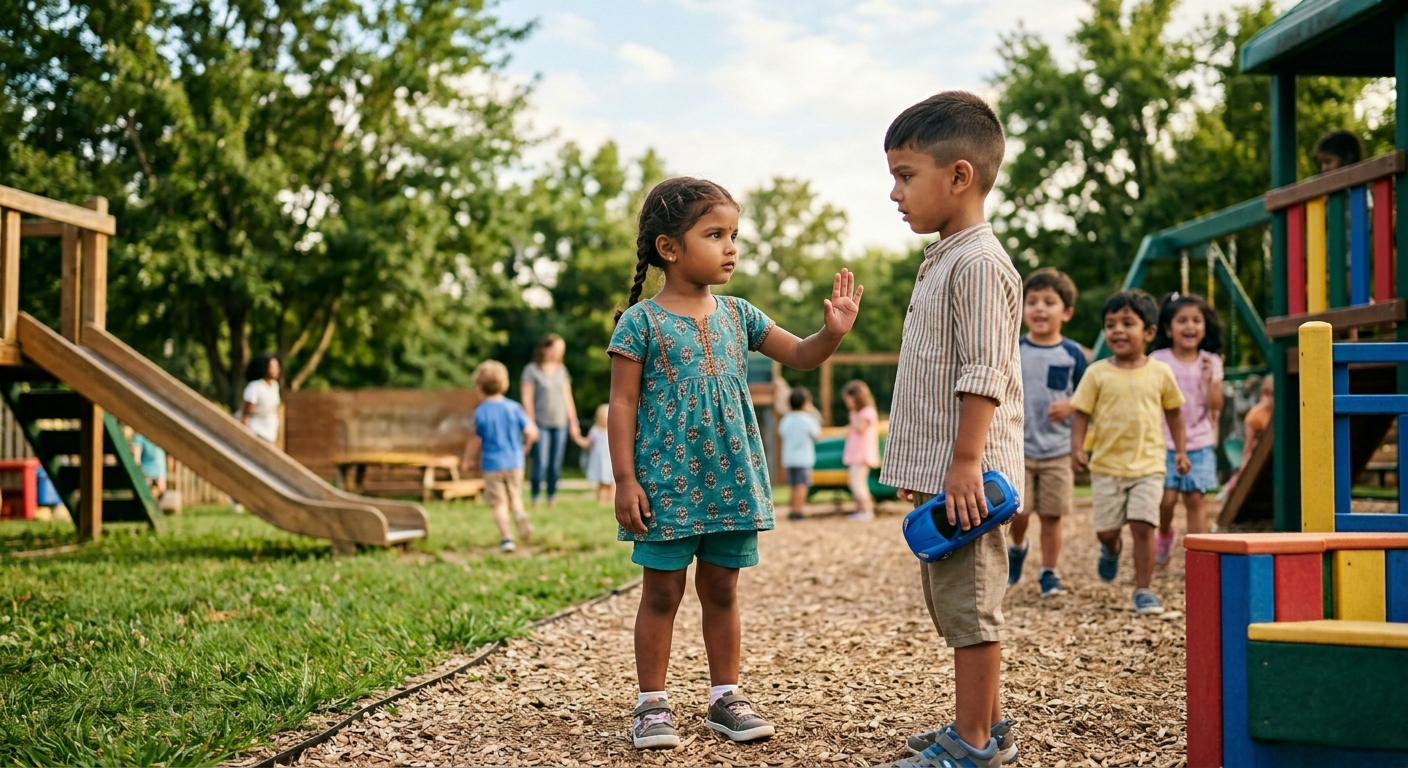
If you work with young children long enough, whether in a classroom, a park or a birthday party that suddenly resembles a mini wrestling arena—you will inevitably witness the “bully moment.” One child grabs a toy, pushes another or declares themselves the emperor of the slide.
Bullying doesn’t begin in teenage years. It begins in the early childhood playground, often unintentionally. At this stage, children are still learning empathy, boundaries and social negotiation.
The good news? These moments are not disasters. They are opportunities to teach children some of life’s most important social skills. At Niño & Niña Preschool, we believe in preparing children to handle such moments independently rather than turning every playground disagreement into an adult intervention.
Below are some simple but powerful techniques we practice with children and recommend to parents as well.
1. Teach Children the Power of Words
The first defense against a bully is not strength—it is confidence. Even three-year-olds can learn to express boundaries clearly.
We encourage children to say simple sentences such as:
• “Please don’t push me.”
• “I am playing with this.”
• “No.”
• “You can wait for your turn.”
Young children often bully simply because no one has told them “no” before. A firm voice from a peer can sometimes stop the behaviour instantly.
In our classrooms, teachers model these sentences during role-play games. Children practice them the way they practice rhymes.
2. Encourage Problem Solving Before Adult Rescue
It is tempting for adults to jump in immediately. But constant rescue teaches children dependence rather than resilience.
At our preschool, teachers observe first. If the situation is safe, we allow children a few moments to resolve the conflict themselves.
You would be amazed how often children negotiate solutions like seasoned diplomats:
• “You take the red car, I take the blue one.”
• “Let’s play together.”
When children solve their own problems, their confidence grows tremendously.
I remember an incident with my nephew when he was about three years old. At a park, another child kept snatching his toy truck. Like any loving Bua, my first instinct was to march over and reclaim the toy with the authority of a Supreme Court judge.
But fortunately the educator in me overpowered the bua in me. Instead of rescuing him, I gently told him, “Go tell him that it’s your toy.”
My nephew hesitated, shuffled over to the child and in a tiny but determined voice said, “This is mine.”
The other child looked surprised… and handed it back.
That small moment taught him something extraordinary.
He learned that he had a voice.
No parenting book, motivational lecture or moral story could have taught him that lesson as effectively as that real-life experience did.
(Sometimes the best gift we can give children is the chance to handle small challenges themselves.)
3. Teach Children to Walk Away
Sometimes the smartest move is not confrontation but disengagement, even in adulthood.
If a child repeatedly pushes or grabs toys, we teach children a very practical strategy: walk away and find another activity or friend.
This does two things:
• It removes attention from the bully.
• It teaches emotional self-control.
For a three-year-old, choosing to walk away instead of pushing back is actually a big achievement.
4. Build Physical Confidence Without Encouraging Aggression
Confidence often reduces bullying.
Simple activities like climbing, running games, balancing and group sports help children feel physically capable. A confident child carries themselves differently and bullies tend to target children who appear unsure.
We often incorporate movement-based activities that allow children to experience their own strength and coordination.
5. Teach Empathy to the Child Who Is the Bully
Here is the uncomfortable truth: sometimes your child might be the bully. And this doesn’t mean they are a bad child. It simply means they are still learning social behavior.
When we observe aggressive behavior at preschool, we don’t shame the child. Instead, we guide them through questions like:
• “How did your friend feel when you pushed him?”
• “What can we do to make it better?”
Children are then encouraged to apologize or help their friend.
Empathy, like reading or writing, must be taught.
6. Avoid Overreacting as a Parent
One of the biggest mistakes parents make is turning small playground conflicts into major dramas.
Children watch how adults react. If parents respond with anger or panic, the child may feel helpless rather than empowered.
A calmer response might sound like:
“Next time you can say ‘Please don’t do that.’ If it continues, you can ask a teacher or adult for help.”
This keeps the child confident instead of fearful.
Teaching children to deal with bullying is not about raising fighters.
It is about raising confident, kind and emotionally intelligent individuals who know how to:
• express boundaries
• respect others
• solve conflicts
And occasionally, defend their toy truck with great dignity.
Because in the grand university of life, the playground is often the very first classroom.
–Divya Joshi
Co-Founder, Niño & Niña Preschool






Shagufta Junaid
April 18, 2026Really loved reading this Divya Ma’am. Such an important topic, explained so beautifully. It truly helps parents understand how to support their children and gives a positive, practical perspective on handling bullying in the early years.
Namrta
April 18, 2026This is a very helpful and practical blog on handling bullying in young children. It explains the importance of teaching confidence and clear boundaries in a simple way. The example sentences are easy for kids to use. I also like the focus on encouraging children to solve small problems independently. Overall, it offers useful guidance for parents and teachers.
Deepika
April 18, 2026Penned down so nicely by Divya Mam.. these are the day to day things that our kids face..and you all are preparing them well embodying empathy as well as teaching them how to take a stand for urself..
Anagha Pande
April 18, 2026Very well explained. These are simple yet powerful tips for raising our kids. Thank you Ma’am.
Divya Aggarwal
April 18, 2026Such an important reminder that assertiveness and kindness can go hand in hand. We don’t need to raise kids who overpower others, but ones who know their worth and can stand their ground with respect. This is beautifully written and very relevant. Reading this made me pause and reflect. It’s so easy to say “stand up for yourself,” but the way we teach it really matters. Guiding kids to be confident yet compassionate is the real win. Loved every bit of this.
Swati Goswami
April 18, 2026I was looking for something like this for so long—guidance on how to handle such situations. This is such a classic example, and I see it with my own child too. He is very innocent and often just stands aside, watching when another child pushes him or takes away the toy he’s playing with.
This blog really helped me understand how to guide him better and build his confidence to respond instead of just observing. Thank you, Divya ma’am, for sharing such practical and relatable advice—it truly gives parents clarity on how to handle these moments.It’s reassuring to know that the teachers are carefully observing such situations and helping children learn how to handle them with confidence.
Neha Monga
April 18, 2026This is so good and very well explained. It provides guidance to us as parents in building confidence and teaching our little one to deal with any kind of such situation wisely. Thank you Divya Ma’am for sharing your thoughts on this important topic.
Shikha Sethi
April 18, 2026Thank You Divya Ma’am for this blog. This blog beautifully highlights the real-life challenges children face today, especially when it comes to bullying. I really appreciate how it not only emphasizes empathy but also teaches kids the importance of standing up for themselves with confidence. The practical approach, along with simple and easy-to-use example sentences, makes it very relatable for young children. It’s great to see the focus on encouraging independence and helping kids handle small situations on their own. Overall, a very insightful and helpful piece for both parents and educators.
Shalu Priya
April 18, 2026As a parent, I truly connected with this message because children learn some of life’s most important lessons through small everyday experiences rather than lectures. The playground is often their first classroom, where they learn confidence, boundaries, sharing, empathy, and resilience. I strongly believe our role as parents is to guide them to use their voice, walk away when needed, and handle conflicts with kindness instead of solving every problem for them. It is also a reminder for us to stay calm and supportive, because every small challenge can become an opportunity for growth and learning.
Rajat Rajgaria
April 18, 2026Thank you, Divya Ma’am, for this incredibly insightful and beautifully written post. These practical strategies are truly invaluable. I deeply appreciate the focus on empowering children to use their voice—it’s a vital lesson in resilience.
Jyoti
April 18, 2026Thanks Maa’m for touching such an important topic and mentioning practical solutions which will help both educators & parents. Indeed very useful.
Manali Arora
April 20, 2026So insightful. Such beautifully penned down take aways to handle situations like these. Thank you, Ma’am, for this blog!