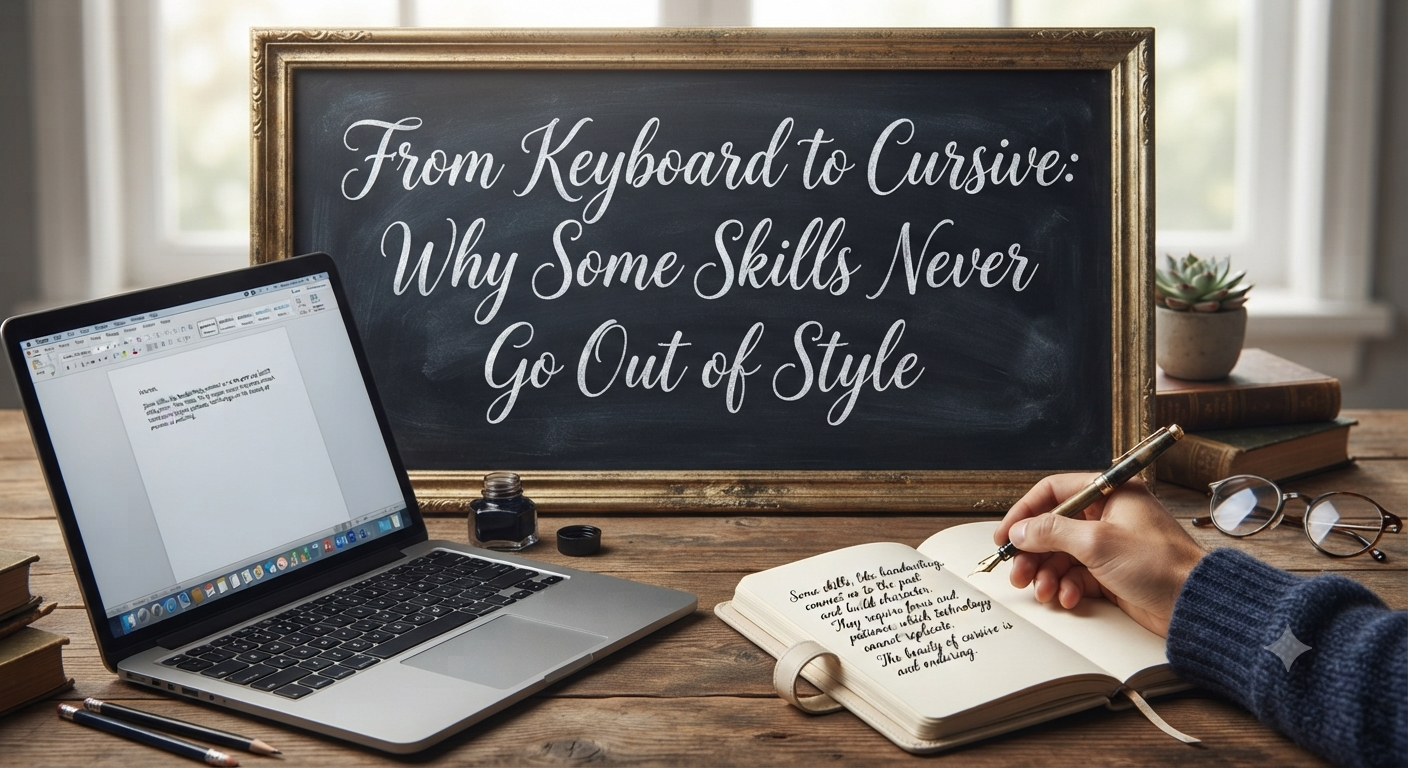
We live in an age where children can ask AI to write a story, dictate a message instead of typing it, and probably find an app to remind them where they kept their pencil! Technology has changed the way we learn, work and communicate. Yet, some skills remain timeless—not because technology cannot replace them, but because they contribute to the making of a well-rounded human being.
Good handwriting, especially cursive writing, is one such skill.
I often hear parents say, “But Ma’am, when my child grows up, everything will be on a laptop. Why does handwriting matter?” It is a perfectly logical question. After all, how many adults today actually write pages of letters by hand? But handwriting is not merely about producing pretty letters on a page. It is a learning skill that involves coordination, concentration, memory, sequencing and fine-motor control.
When a child writes by hand, the brain is not simply instructing the fingers to move. The child is recognising letters, remembering their formation, controlling pressure, coordinating hand and eye movements and organising thoughts. Cursive writing adds another layer because letters flow into one another, encouraging smooth and continuous movement.
And then there is the practical side.
I have seen children who are excellent at tapping away on a tablet struggle when asked to write a few sentences independently. Their ideas are ready, their vocabulary is good, but their hands tire quickly.
Cursive writing also teaches patience. There is no “undo” button when a letter goes wonky. No Ctrl+Z. The child learns to slow down, observe, practise and try again. In a world of instant responses, that is a valuable lesson in itself.
This does not mean we should choose pencils over technology. Children need both. Digital literacy will undoubtedly be essential for their future, but so will the ability to think, communicate, concentrate and use their hands effectively.
The purpose of education is not to predict which tools a child will use twenty years from now. It is to give them a strong foundation so they can adapt to whatever comes next.
AI may write the words. A keyboard may type them. But the ability to put a thought onto paper—with clarity, patience and a little personality—is a skill worth preserving.
Because some things don’t become outdated.
They become timeless.
– Divya Joshi
Co-founder
Niño & Niña Preschool