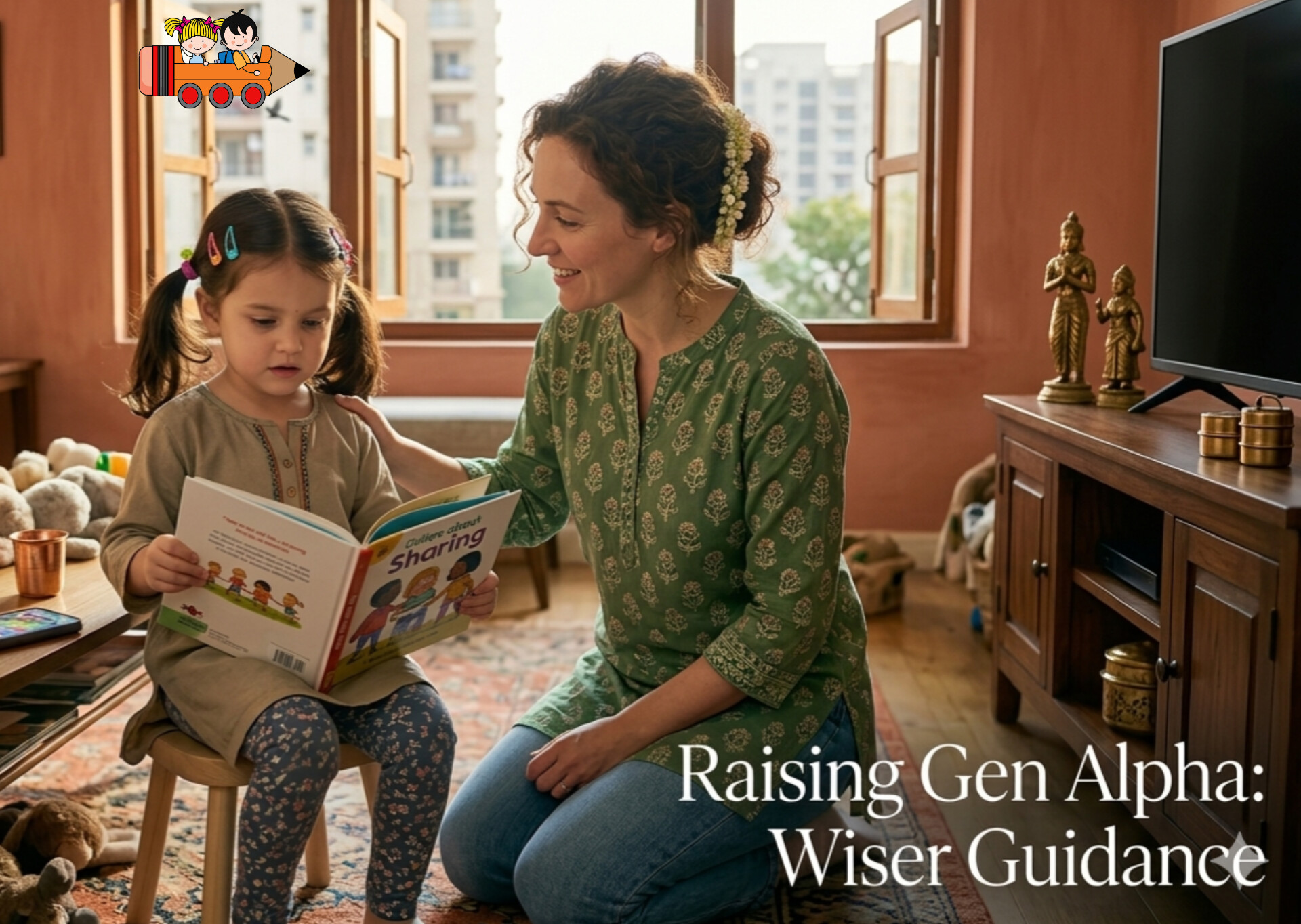
A three-year-old today can unlock a phone, skip ads on YouTube and swipe through photos faster than many grandparents.
But ask the same child to wait for their turn in a game, suddenly the room feels very unfair.
This is the paradox of raising Gen Alpha.
They are the most technologically comfortable generation in history, yet they are still learning the timeless human skills that no device can teach: patience, resilience, empathy and the ability to handle frustration.
And that is exactly why parenting Gen Alpha requires something new.
Not stricter rules.
Not more gadgets.
But wiser guidance.
Every generation of children quietly forces adults to reinvent parenting. First came the disciplined Gen X, then the highly protected Gen Z and now the newest little humans have arrived—Gen Alpha. These are children born roughly from 2010 onwards, growing up in a world where a voice command can switch on lights, cartoons appear on demand and even grandparents know how to video call.
In simple words, Gen Alpha children are growing up faster technologically but slower emotionally. And that means parenting styles must evolve too.
The challenge is not that these children are “different.” The challenge is that many adults are still parenting with yesterday’s methods.
Let me explain.
Gen Alpha: The Children of Instant Everything
A Gen Alpha child lives in a world of instant results.
Hungry? Food arrives through an app.
Bored? A tablet appears.
Curious? The internet answers immediately.
Technology has brought remarkable convenience, but it has also quietly changed childhood. Screens provide constant stimulation, quick rewards and endless entertainment. While useful in moderation, excessive exposure can reduce attention span, patience and the ability to engage deeply with real-world experiences.
A screen never asks a child to wait their turn.
A tablet never argues over a toy.
A cartoon never teaches how to resolve a disagreement.
Real life does.
Many parents today are extremely loving and involved, which is wonderful. But sometimes love unintentionally becomes over-assistance.
A child struggles with a puzzle for two minutes… and an adult solves it.
A child complains about boredom… and a new activity or toy appears instantly.
A child resists instructions… and negotiations begin.
The result? Children grow up expecting the world to adjust around them.
But the world doesn’t work that way.
The Parenting Shift Gen Alpha Needs
Raising Gen Alpha requires a delicate balance: warmth with structure.
Children need freedom to explore, but they also need boundaries that help them understand effort, patience and responsibility.
Instead of solving problems for them, we must teach them how to stay with a problem a little longer.
Instead of eliminating frustration, we must help them handle frustration.
In short, Gen Alpha doesn’t need stricter parents.
They need steadier parents.
What We Do at Niño & Niña Preschool
At our preschool, we see this generational shift every single day. And it has gently shaped the way we guide our little learners.
One conscious decision we have made is to keep the preschool environment completely technology-free for children. There are no tablets for learning, no screens for entertainment and no digital shortcuts for engagement.
This is intentional.
Because when screens disappear, something beautiful happens—children begin to interact with the real world again.
They build.
They negotiate.
They imagine.
They create.
And most importantly, they connect with people.
1. Teaching Patience Through Play
Children today are used to fast stimulation, so we intentionally introduce activities that require waiting and turn-taking.
During group games, children learn that not everyone can go first. Sometimes you must wait, observe and cheer for your friend.
It sounds simple, but for a three-year-old in the age of instant gratification, this is a powerful lesson.
2. Encouraging Problem Solving
When a child says,
“Ma’am, it’s not working!”
Our first instinct is not to fix it.
Instead we ask,
“Hmm… what do you think we can try?”
You should see the sparkle when they discover the solution themselves. That confidence cannot be downloaded from the internet.
3. Building Real Social Skills
Screens cannot teach children how to read expressions, negotiate with friends or resolve tiny conflicts.
During pretend play, block building and group activities, children naturally learn how to communicate.
Sometimes a disagreement happens.
Instead of immediately intervening, we guide them to express their thoughts:
“I didn’t like that.”
“Can I have a turn?”
“Let’s build together.”
These are tiny conversations today—but they build emotionally intelligent adults tomorrow.
4. Teaching Responsibility Early
Something as simple as putting away toys or carrying their own water bottle builds responsibility.
At our preschool, children learn that every activity has a beginning and an end where we clean up together.
It may look like a small routine.
But routines quietly build discipline.
What Needs to Happen at Home
Parents are the most powerful influence in a child’s development. Schools can guide, but habits are built daily at home.
Here are a few gentle shifts that help Gen Alpha thrive.
1. Let Children Experience Small Struggles
If a child cannot open a snack box immediately, resist the urge to jump in.
Those few seconds of effort build problem-solving muscles.
Struggle is not harm.
Struggle is learning.
2. Be Mindful of Screen Exposure
Since Gen Alpha children are already surrounded by technology everywhere, home is where balance must be created intentionally.
Screens should not become the default solution for boredom, eating time or calming a child.
Instead encourage:
• free play
• drawing
• building blocks
• storytelling
• outdoor play
A child who learns to play without screens develops imagination, focus and creativity.
3. Reduce Instant Entertainment
Boredom is not a problem. It is the birthplace of imagination.
Some of the most creative play begins with a child saying,
“I don’t know what to do.”
Give them space to figure it out.
4. Set Clear Boundaries
Children feel safer when expectations are clear.
Bedtime means bedtime.
Clean-up means clean-up.
Consistency builds security.
5. Model the Behaviour You Want
Children imitate adults far more than they obey them.
If we expect patience, kindness and calm behaviour, they must see it in us first.
Yes, easier said than done, especially after a long day.
But parenting has always been the most demanding leadership role.
The Real Goal
The goal of raising Gen Alpha is not to make life easy for them.
The goal is to prepare them for life.
These children will grow up in a world we can barely imagine today—full of technology, opportunities and challenges.
What they will need most are timeless human skills: patience, resilience, empathy and curiosity.
And those skills are built in the simplest places.
At a classroom activity table.
In a family living room.
During a small moment when a child tries again instead of giving up.
Raising Gen Alpha is not about controlling children.
It is about guiding them to become capable human beings.
And if we do it right, the generation everyone worries about today may become the generation that surprises us the most.
-Divya Joshi
Cofounder, Niño & Niña Preschool








Heena
March 13, 2026Hi Ma’am ,blog’s insights on adapting parenting approaches for Gen Alpha are super valuable.You’re bringing some much-needed fresh perspectives to the table! 😊 Keep sharing your insights .
Shaista : Inaaya’s Mom
March 13, 2026An eye opening blog for all the parents. Today We make sure our kids have all the comfort in the life and later when this reflects on their attitude we will be the ones complaining saying you always wants to be in comfort zone and then we will realise it was the problem created by us when they were young and at learning phase of their life. This is what we have taught them.
Our parenting is the reflection of kids life style and attitude. Thank you writing this relatable blog. I have some learning from this which I am going to work as a parent and try to bring some changes in my parenting way.
Batool Zehra
March 13, 2026I really enjoyed your article on raising Gen Z. You captured the challenges and opportunities of parenting this generation in such a thoughtful and balanced way. Your insights about understanding their digital world, encouraging independence, and building genuine communication really resonated with me. It’s refreshing to read something that highlights not just the struggles, but also the strengths and potential of Gen Z. Thank you for sharing such a meaningful perspective. I also have learned that i also need to work on my own self in order be the part of their changing world…
Pallavi Rawat
March 13, 2026Great read! This is a really insightful post. This generation is growing up in such a different environment compared to previous ones and you captured that shift very well.
Yavnika Thapa
March 13, 2026It’s a strong read and well put! Small hanits create big or long term impact! I could see myself in those lines and dilemma I face on everyday basis while raising my daughter! Where to say no, to have consistent boundaries, if it is a No today , it’s a No tomorrow also! This is conscious but I also learning! Thankyou for putting this out so simplistically , and reminding us to be better everyday! Like you said easier said than done! What we need to be is steady !!
Neha Vijayvargy
March 13, 2026Thank you for sharing such a thoughtful blog about Gen Alpha and the importance of real-life experiences for children. It’s wonderful to see the school encouraging healthy habits and creating a calm environment where children can sit together and enjoy their meals. When kids see that everyone is getting the same food and are encouraged to eat on their own, it helps them understand and appreciate their food better. This kind of routine not only builds independence but also helps children develop a positive and healthy relationship with food. We truly appreciate the school’s efforts in supporting these habits.
Pooja Rajput
March 13, 2026Your article is very insightful and clearly highlights the gaps and challenges in modern parenting. In reality, we become parents without any formal training in child development or caregiving. Because there is no structured handbook for parenting, we often face emotional and practical challenges while raising children. Your article is truly eye-opening and provides valuable perspective, functioning like a practical guide for understanding and managing contemporary parenting. Thank you, ma’am.
Juhi
March 13, 2026A thoughtful and timely reflection on the realities of raising Gen Alpha. I particularly appreciated the emphasis on building emotional skills alongside curiosity and creativity, which is truly the need of the hour as shrinking family sizes mean fewer natural opportunities for children to develop these skills. Appreciate the efforts Divya and team Nino & Nina
Shipra Gupta
March 13, 2026This blog beautifully captures the essence of raising Gen Alpha—reminding us that parenting today is about empathy, guidance, and preparing our children for a future full of possibilities. I truly appreciate the way it blends tradition with modern insights, making it so relatable for parents like me who have a Gen Alpha at home too.
Jyoti
March 13, 2026Being an eductor of Gen Alpha Kids, the blog nails challenges & suggests awesome suggestions.
Sharing is one habit we find most challenging to inculcate in class as the kids have “everything is mine” mindset.
Archna Jain
March 13, 2026These insights are very valuable, as sometimes we don’t know how to handle these situations and if the challenges we are facing are common parenting challenges or unique to our kid. Such articles make us aware of the challanges and how to effectively navigate through these.
Rashi Jalan
March 15, 2026Such a thoughtful and relatable post ma’am. Parenting today comes with many decisions, and your words beautifully highlight how small actions shape a child’s mindset and future. It was truly inspiring to read.
Shikha Sethi
March 13, 2026A beautifully written blog with a strong message. Parenting in today’s world is not easy, and this article highlights the importance of setting the right boundaries and nurturing the right habits from an early age. Thank you for sharing these valuable insights.
Visheshta : Maisaa's Mom
March 14, 2026Beautifully written blog!! I can relate to it. Each pointers has its own impact. Thanku for giving words to our struggle and providing guidance to tackle the situation through this. Kudos!!!
Meenakshi
March 16, 2026We often focus on the outcome and overlook the process. Yet, it is the journey that shapes strong, capable human beings. Parents of Gen Alpha must make conscious choices and create the right structure to ensure this generation grows smarter than its predecessors—not only in technology but also in human skills.
Parents have to first recognize that technology should remain an enabler and not become a doer. Discipline and intentional parenting are essential. We must invest time with our children and actively involve them in creative and productive activities.
Screens may be inevitable today, but their extent and purpose must be carefully managed. A screen often creates a one-way interaction—a monologue—rather than meaningful communication. It limits a child’s ability to think independently, question ideas, and explore alternative solutions. Replace it with books and real life experiences.
My experience at Niño & Niña reinforced that this balance is absolutely achievable—provided parents are willing to anticipate the consequences and make mindful choices early on.
Manali Arora
March 17, 2026Such a thoughtful and relevant reflection.
“The goal of raising Gen Alpha is not to make life easy for them, but to prepare them for life.” Creating spaces where children experience patience, small struggles and real-world interactions is truly the greatest gift—helping them grow into capable and resilient individuals.
Prachi Jain
March 27, 2026Thank you, Divya, for this incredibly timely and insightful post! Your point that ‘a screen never asks a child to wait their turn’ really struck a chord with me. In today’s fast-paced world, it is so easy to fall into the trap of offering instant entertainment or jumping in to solve our children’s problems right away. This article is a wonderful reminder that allowing our kids to experience ‘small struggles’ is actually a vital part of their learning and development. I absolutely love the philosophy that our goal isn’t to make life easy for Gen Alpha, but to prepare them for life. I am definitely going to focus on being a steadier parent and creating more screen-free space for imagination at home!