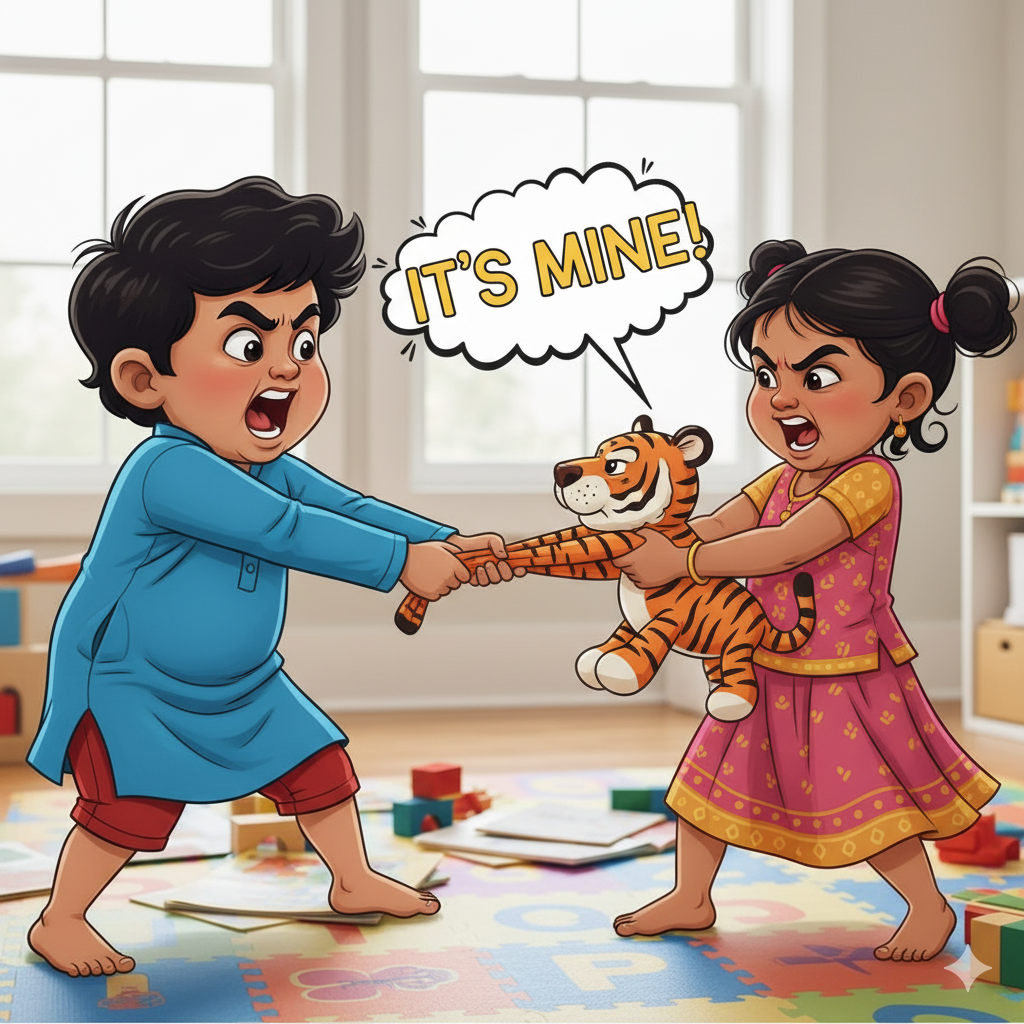
There you are, sipping your third cup of coffee, watching your adorable little one play peacefully with a friend. Suddenly, a toy becomes the Holy Grail, and your sweet child turns into a determined little warrior, yelling, “It’s MINE!”—and snatches it like a toddler version of Indiana Jones.
Welcome to the magical, messy and mildly maddening world of toddler ownership.
Why Do Toddlers Snatch and Shout “Mine!”?
Let’s clear one thing upfront: your child is not turning into a tiny tyrant. Toddlers, typically between 1.5 to 3.5 years, are in a crucial developmental stage where possessiveness is a sign of growth, not greed.
Their brain is busy doing big things—figuring out personal identity, asserting independence and learning boundaries. So when they snatch a toy and claim, “It’s mine,” what they really mean is, “I like this,” or “I’m still playing with it,” or “This makes me feel safe.” Sharing, in their world, is not a natural instinct—it’s a taught social skill, just like using a fork or saying “please.”
How We Manage the “Mine” Syndrome at Niño & Niña
At Niño & Niña Preschool, we embrace toddler behaviour with empathy, strategy and a pinch of humour. Here’s how we handle it in school:
1. Playful Turn-Taking
We use fun strategies like singing the “Sharing Song” or playing games that involve passing objects around in a circle. These gently teach the concept of waiting and taking turns without sounding preachy.
2. Role-Play and Story Time
Stories are our magic potion. Stories like, “The Rainbow Fish” become the perfect teaching tools. Children relate to characters and understand that sharing is kind, not catastrophic.
3. Labeling Emotions
When a child snatches something, instead of a stern “No!”, we say, “I see you really wanted that toy. It’s hard to wait, isn’t it?” Naming the emotion helps toddlers feel heard and less likely to burst into Hulk-mode.
4. Setting Clear Rules with Consistency
We avoid vague instructions like “Be nice!” and use simple, concrete phrases like, “First Vedika plays, then it’s your turn.” The rule is reinforced every time, not just when things escalate.
5. Personal Space and Ownership Zones
Each child has a labelled cubby or bag where personal items stay untouched. This teaches ownership within boundaries, and helps them understand what’s shared and what’s not.
How Parents Can Help at Home (Without Losing Their Sanity)
Don’t worry, we won’t tell you to narrate a TED Talk on sharing to your toddler. But here are some real, doable ideas you can try at home:
1. Start With “Taking Turns” Instead of “Sharing”
Sharing feels like forever in toddler-time. Taking turns sounds fairer. Use timers or sand clocks to mark turns. You’ll be amazed at how this changes their attitude.
2. Model the Behaviour You Want to See
Children copy what they see, not what they hear. If you say, “Can I please borrow your pen?” to your partner and smile while handing it back, your child learns it faster.
3. Let Them Own Something Completely
Allow your child to have a toy or two that they are not expected to share. This satisfies their need for control and reduces general possessiveness in shared play spaces.
4. Acknowledge Feelings Before Redirecting
If your child grabs a toy, first validate their feelings (“You really wanted to play with that, huh?”) before guiding them to wait or use another toy.
5. Stay Calm During Snatching Episodes
Snatching doesn’t mean your child is bad, it means they’re still learning. Reacting with frustration only creates power struggles. Instead, use it as a teaching moment.
The next time your toddler screeches “Mine!” while gripping a rubber ducky like it’s a bar of gold, take a deep breath and remember, it’s not a flaw, it’s a phase.
At Niño & Niña, we treat it as an opportunity: a teachable, sometimes giggle-worthy moment to guide children into becoming empathetic and cooperative little humans.
After all, before they can learn to give with joy, they must first understand what it means to have something of their own.
So hang in there, dear parent. You’re not alone in the toddler tug-of-war and if you need support, we’ve got plenty of stories (and strategies) to share.
And no, we won’t snatch your coffee. That’s all yours.
Divya Joshi
Co Founder, Niño & Niña